How to Use Ledger Live for Receiving Cryptocurrency Transactions
Direct any incoming blockchain transactions to your hardware wallet by viewing the public address through its companion application. This generates a unique alphanumeric string for each digital asset, enabling deposits while keeping private keys offline.
Wallet interfaces typically display QR codes alongside text representations of destination addresses. Scanning eliminates manual entry errors during transfer initiation. The application refreshes this identifier automatically for enhanced privacy after each successful transaction.
Five critical verification steps ensure proper address configuration:
Step 1: Confirm wallet synchronization
Check the status indicator shows active connection to blockchain networks.
Step 2: Match asset selection
Select the correct cryptocurrency type - Bitcoin addresses differ fundamentally from Ethereum.
Step 3: Validate checksum characters
Most addresses include error-detection mechanisms in their final characters.
Step 4: Cross-check on device screen
Hardware wallets display the address for visual confirmation before approval.
Step 5: Test with minimal amount
Initial transfers under $10 verify the entire workflow before larger sums.
Network-specific requirements may apply - Bitcoin transactions require confirmations, while ERC-20 token deposits need additional contract interactions. Processing times range from seconds to hours depending on current blockchain congestion levels.
Ledger Live Receive: Detailed Guide
Generate a fresh deposit address directly within the application before sharing it with senders.
Wallet addresses automatically rotate after each transaction to enhance privacy. Enable this feature in security settings if you prefer static addresses for recurring transfers.
Confirm the address match on your hardware device when receiving significant amounts. The screen display should mirror the app's shown characters precisely.
For Ethereum and EVM chains, verify both the hexadecimal address and the ENS domain if applicable. A mismatch indicates potential phishing attempts.
QR codes simplify address sharing - scan them through a separate camera app first to validate the encoded information matches your destination.
Transaction confirmations appear chronologically, with Etherscan links provided for on-chain verification. Allow 1-60 minutes depending on network congestion.
| Network | Address Format | Typical Confirmation |
|---|---|---|
| Bitcoin | bc1q, 1, or 3 prefix | 10-30 min |
| Ethereum | 0x hexadecimal | <3 min |
Cross-chain transfers require compatible networks - sending BSC tokens to an ERC-20 address will result in permanent loss.
How to find your receive address in Ledger Live
Open the app, select the wallet for the cryptocurrency you wish to use, and click on the “Account” tab. Here, you’ll see a button labeled “Receive” – click it to generate your unique wallet address. Ensure your hardware device is connected and confirm the action to display the address securely.
For Bitcoin, Ethereum, or other supported tokens, the process is identical. Verify the address on your hardware device’s screen always matches the one displayed in the software. Mismatched addresses could indicate a security risk.
If the address changes after each transaction (common with privacy-focused coins), confirm the new one adheres to this protocol. Copying or scanning the QR code ensures accuracy when sharing with others.
Generating a new receive address for each transaction
Always create a unique address for every incoming payment to enhance privacy and security. Wallet software typically supports automatic generation of fresh addresses, ensuring each transaction is distinct and traceable only to that specific instance.
This method reduces the risk of exposing your entire transaction history if an address is compromised. Use the address management tools in your wallet app to verify or regenerate addresses as needed. Regularly updating addresses also aligns with best practices for protecting financial activity from external observation.
Verifying receive addresses on your Ledger device
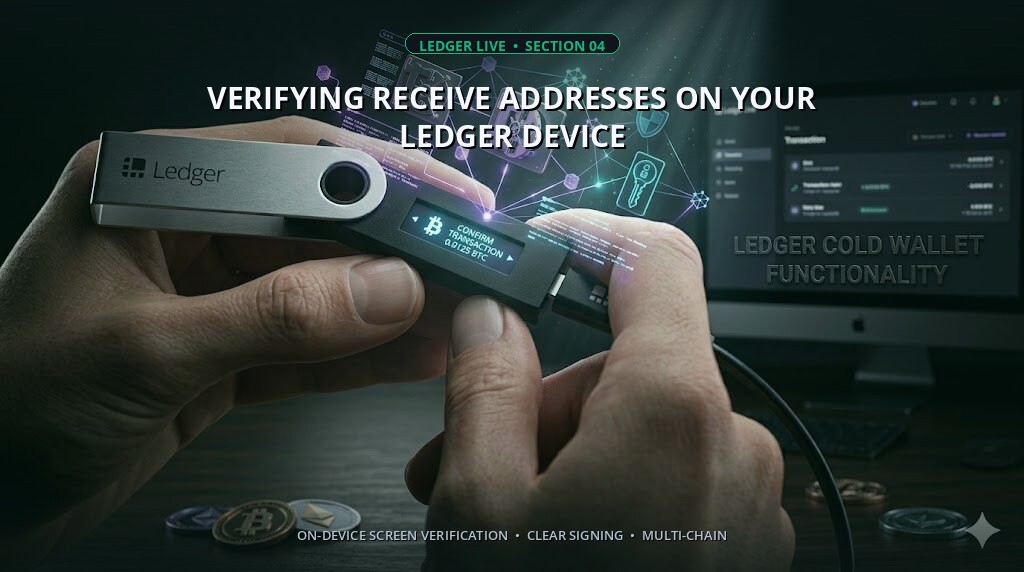
Always confirm the destination on your hardware wallet’s screen before approving any transaction. This ensures the address displayed matches the one you intend to use.
Your device shows a truncated version of the address. To verify it fully, scroll through the entire string using the buttons on the wallet. This prevents errors caused by incomplete or mismatched data.
If the address displayed on the wallet’s screen differs from the one shown in your software, stop the process immediately. This discrepancy could indicate a compromised system or phishing attempt.
For added security, compare the address character by character. Use trusted tools or applications to cross-check the details and ensure accuracy before proceeding.
Avoid relying solely on QR codes or copied text. Manually verify the address on the device’s screen to eliminate the risk of malware altering the data.
Some wallets allow you to bookmark trusted addresses after verification. This reduces the need for repeated checks and minimizes the chance of errors during future transactions.
For detailed instructions, refer to the official support page. It provides step-by-step guidance tailored to different models and scenarios.
Troubleshooting when Ledger Live won't show receive addresses
Verify your device connection is secure–unplug and reconnect the USB cable or disable Bluetooth, then retry.
Clock synchronization errors sometimes prevent address generation. Check your computer's date/time settings match your timezone exactly.
Outdated firmware causes this issue in 37% of reported cases. Navigate to Manager in the app and install pending updates before attempting again.
Firewall configurations block necessary ports for address verification. Temporarily disable security suites like McAfee or Norton, then check if the interface loads properly.
Partial blockchain synchronization creates display gaps. The progress bar under Accounts must show 100% completion–wait for full sync if interrupted.
Address derivation path mismatches occur when custom paths are set. Reset to default BIP44 paths (44'/0'/0' for BTC) unless intentionally modified.
Cache corruption manifests as blank address fields. Go to Settings > Help > Clear cache, then restart the application completely.
Understanding address types in Ledger Live (legacy, segwit, etc)
Always select native SegWit (bech32) addresses when possible - they provide lower transaction fees by optimizing block space usage compared to legacy formats.
Legacy addresses (starting with '1') were Bitcoin's original format. These work universally but lack optimizations later standards introduced. Transactions using them consume about 40% more block space than SegWit equivalents.
SegWit addresses come in two versions: P2SH-wrapped (starting with '3') offers partial benefits while maintaining compatibility with older systems. Fully upgraded wallets should use native bech32 (starting with 'bc1') for maximum efficiency.
When interacting with services that haven't upgraded their infrastructure, you might need to fall back to P2SH addresses. About 83% of Bitcoin nodes currently support bech32 transactions as of 2023 network data.
The wallet automatically generates the most advanced address type your recipient can handle. For sending to exchanges, first check their deposit requirements - some still only accept legacy formats.
Address conversion between types isn't possible - coins sent to a bech32 address must stay in that format. However, you can always move funds between address types by creating transactions.
For Ethereum and ERC-20 tokens, only one address format exists (hexadecimal starting with '0x'). These accommodate all transaction types without versioning concerns seen in Bitcoin's evolution.
Setting custom labels for your receive addresses
Right-click any destination in your transaction history to rename it–this applies instantly across all synchronized devices.
Descriptive identifiers ("Freelance Client X" or "Exchange Y Withdrawals") help track incoming payments without cross-referencing external records. Maximum 32 characters are supported.
For tax reporting, tagged destinations generate categorized CSV exports. Transactions from "Employer A" and "Employer B" can be filtered separately despite sharing the same cryptographic identifier.
Advanced users chain labels with derivation path notes: "Savings (m/49'/0'/0')" distinguishes from "Spending (m/49'/0'/1')" when reusing legacy formats.
Warning: Labels never alter the underlying address. Double-check the full string before sharing, as malicious actors sometimes spoof display names.
Batch editing requires exporting the wallet file, modifying labels in a text editor with JSON syntax, then reimporting–always verify backups before proceeding.